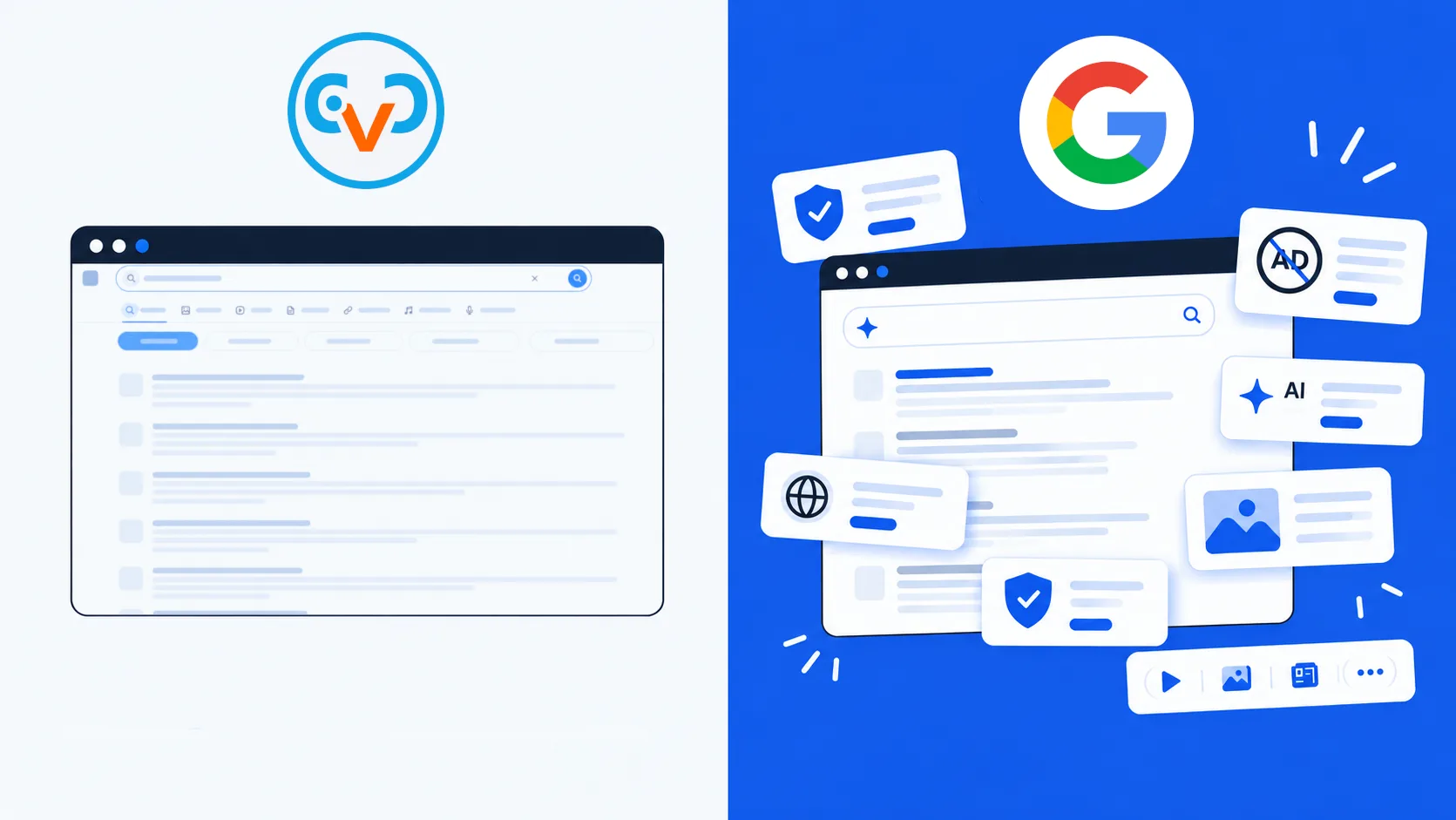
Google is the benchmark for web search, and there is no point pretending otherwise. But as more people ask whether they have to pay for convenience with their data, we decided to set the two approaches side by side. We are writing about ourselves, so you know which side we are on, but we rely on Google’s privacy policy of October 16, 2026 and on our own documents. Where Google is better, we say so plainly.
Who Pays for the Search Engine
Google is free, and as the company states in its own policy, advertising is what allows many of its services to be offered at no charge. Depending on your settings, ads can be personalized based on your interests and activity. Google says it does not personalize ads based on sensitive categories such as religion or health, and many of these mechanisms can be limited in My Ad Center and Activity Controls.
At MevaSearch, a subscription keeps us running. We do not show ads, we do not sell data, and we do not build a profile of your interests. Searches are not assigned to your account and do not create a history. Our servers are located in Lithuania, with backups in France, and the project is built in Poland. This comes at a price: the Lite plan starts at $4.99 a month with 500 searches, while the top plan, Ultra, starts at $59.99 with 8,000. Lite can be tested free for three days.
What Data We Collect
The scope of data Google collects depends on the services you use and your settings. The company lists, among other things, search terms, IP address, browser and device identifiers, and location. It also stores data when you are not signed in, under unique identifiers tied to your browser or device. On the other hand, you can use Google Search without an account, and your activity history can be reviewed, deleted, or set to delete automatically.
With us, an email address is required, and payments are handled by Polar.sh, so we do not store your full card details. Your IP address is kept only in technical logs, for up to 30 days. Queries are not linked to your account, our analytics run without cookies, and we use only the cookies necessary for the service to work. We are not cut off from the outside world, though. Queries are sent anonymously to result providers such as Brave Search and Mojeek. Site icons and thumbnails from Brave are loaded directly by your browser, so their provider sees your IP address in that case. You can turn them off in settings.
AI
AI summaries in MevaSearch currently run on Google Gemini. We send queries without account details or identifiers, and under the terms of the paid service we use, Google does not train its products on them. You can switch the summaries off with a single toggle, and AI buttons can be hidden entirely. Photo search works only with your consent, and before sending, your browser strips hidden information such as location from the file. We do not store the photo.
Results and Personalization
Results come from our own WebAtlas index and from Brave Search and Mojeek, with other sources used in individual tabs. So part of the results comes from partners, and we say so openly.
Personalization with us means control over appearance and layout, not profiling. You choose the interface style, colors, fonts and icons, and you can use themes or your own CSS. Orbit lets you point out, in a simple text file, which sites should rank higher, lower or be hidden, in a format compatible with Brave Goggles. The address of that file is sent along with your query and, for Brave results, also reaches Brave Search, so a rarely used file could in theory act as an identifier. Add-ons label results, for example by warning about paywalls, tracking or ads, and their settings stay on your device. Safety is handled by NetKrypton, which warns about phishing and lets you hide dangerous sites. Within one plan you can create profiles for a family or team, without separate email addresses.
Where Google Wins
Google is free and has no search limit. It offers a broad ecosystem of services such as Gmail, Drive, Photos and YouTube, along with extensive data controls: My Activity, export and automatic deletion. We have a mobile app, a browser extension and MevaSearch Maps, but on a much smaller scale.
Who Should Choose What
MevaSearch is for people who don’t want anyone building a profile of their interests, who like setting up their search engine themselves, and who accept a small fee in exchange for no ads. Google remains a good choice when price and integration with the company’s other services matter most, and when ads don’t bother you or you prefer to manage them in your account settings.
The best way to decide is to try it yourself. Three days with MevaSearch costs nothing, and if a query doesn’t work out, an add-on with quick links lets you run it in another search engine.
What’s Next
One more thing: our team will soon replace Google’s API entirely with Claude AI. We will share the details once the change is ready.
This comparison is based on publicly available information, Google’s privacy policy of October 16, 2026, and MevaSearch documents from October 2026. Prices and features may change, so check the current details on both services’ websites before deciding.