Most of us treat web search as something free. Google, Bing, DuckDuckGo — they're all free. But are they really? In the advertising model, your data and attention are the price. There is, however, a growing niche of search engines that flip this model: instead of paying with data, you pay with money. Here are five search engines that have chosen this path.
Publication date: 16.05.2026.

Kagi – pioneer of the paid model
Kagi (pronounced kah-gee, meaning "key" in Japanese) was founded in 2018 by Vladimir Prelovac and launched publicly in June 2022. The company bootstrapped for five years with ~$3M of the founder's own funds, then raised ~$2.5M from ~93 community investors. In 2024, Kagi was converted into a Public Benefit Corporation.
Kagi operates as a metasearch engine: it aggregates results from other search engines (Google, Brave, Mojeek, and others), supplementing them with its own Teclis index focused on the so-called small web — blogs, forums, and non-commercial content that large search engines increasingly push down the rankings. Its distinguishing features include lenses (thematic filters, e.g. academic articles only or discussions), the ability to permanently block or promote specific domains, and an optionally available AI assistant.
The model is simple: new users get 100–150 free searches (trial), after which a subscription is required. The Starter plan at $5 covers 300 searches per month. Kagi states this is sufficient for around 99% of users. Kagi is the only search engine on this list headquartered in the US, which some European users consider a drawback from a privacy law perspective.

MetaGer – pioneer from Germany
MetaGer is the oldest search engine on this list. The idea was born in March 1996 in the mind of Dr. Wolfgang Sander-Beuermann at the CeBIT trade fair, literally on a paper napkin. That very evening he began work on a prototype. By the end of 1996, MetaGer launched as a research project of the University of Hanover. In 2012, it came under the umbrella of the non-profit association SUMA-EV.
For decades, MetaGer operated on an advertising model. Everything changed in August 2024, when Yahoo unilaterally and without notice terminated its contract — Yahoo had been providing both advertising revenue and search results based on Microsoft Bing. The association faced a choice: shut down the service or switch to a paid model. It chose the latter.
Today MetaGer requires a so-called MetaGer Key, a paid key with a pool of tokens. There is no subscription — it is a one-time token purchase. The search engine remains open source (GNU AGPL license), runs on 100% renewable energy, and offers unique features: a built-in anonymizing proxy (any result can be opened through MetaGer's server, hiding your IP address from the visited site) and access via the Tor network.

Uruky – Privacy without an ecosystem
Uruky is the only search engine on this list that explicitly and by name defines itself in opposition to Kagi. On its "About" page, we read: Kagi almost fulfilled our vision, but went too far with AI features and wants to become an ecosystem (News, Maps, Mail, Drive...). Uruky is deliberately smaller and simpler.
The company, registered in Portugal in 2018, focused on three priorities: privacy, speed, and personalization of search results — without extensive AI features and without additional products. A headquarters in the EU means being subject to GDPR, which has concrete legal significance for European users. Uruky offers a 14-day money-back guarantee — long enough to evaluate the quality of results.
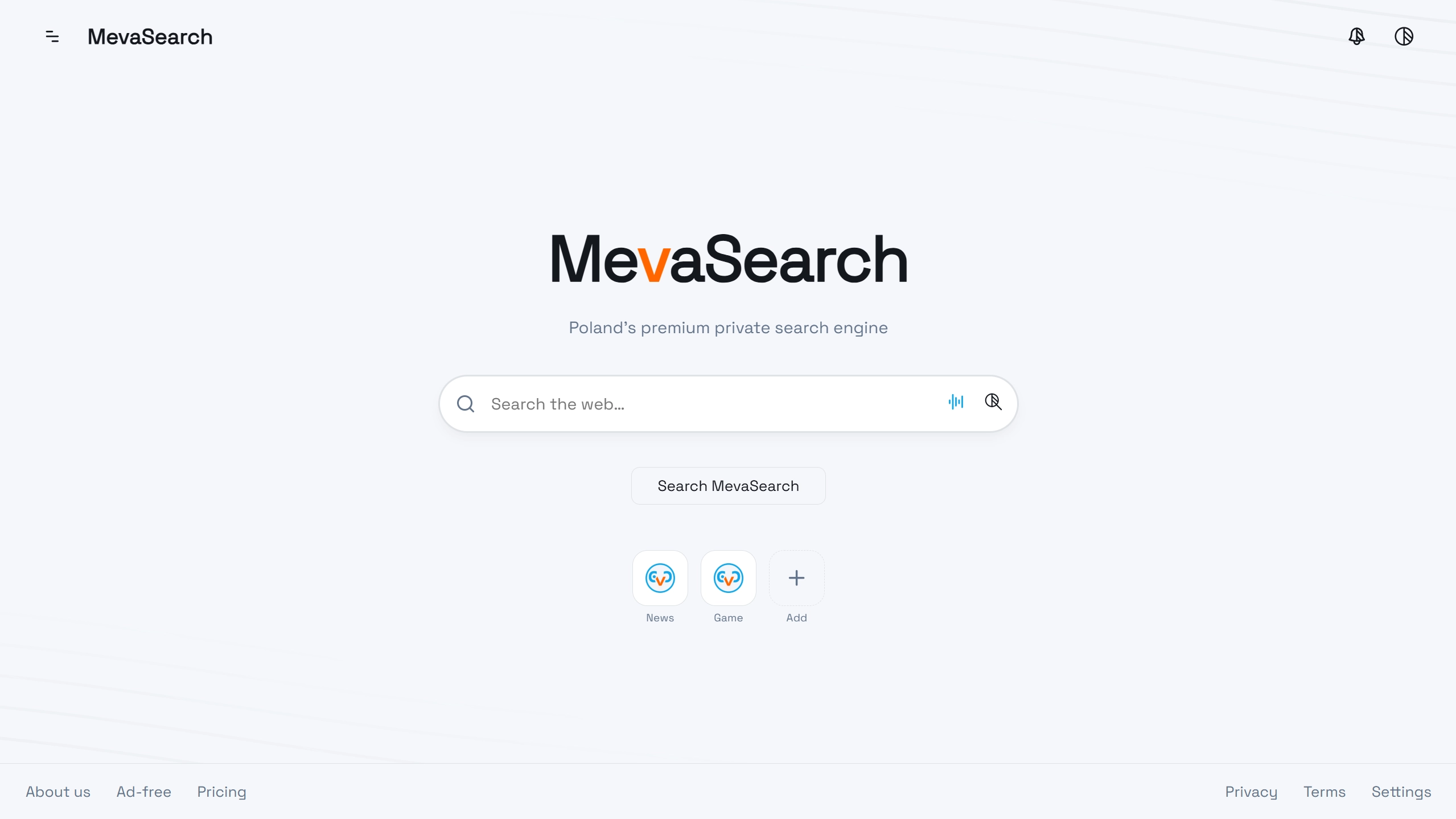
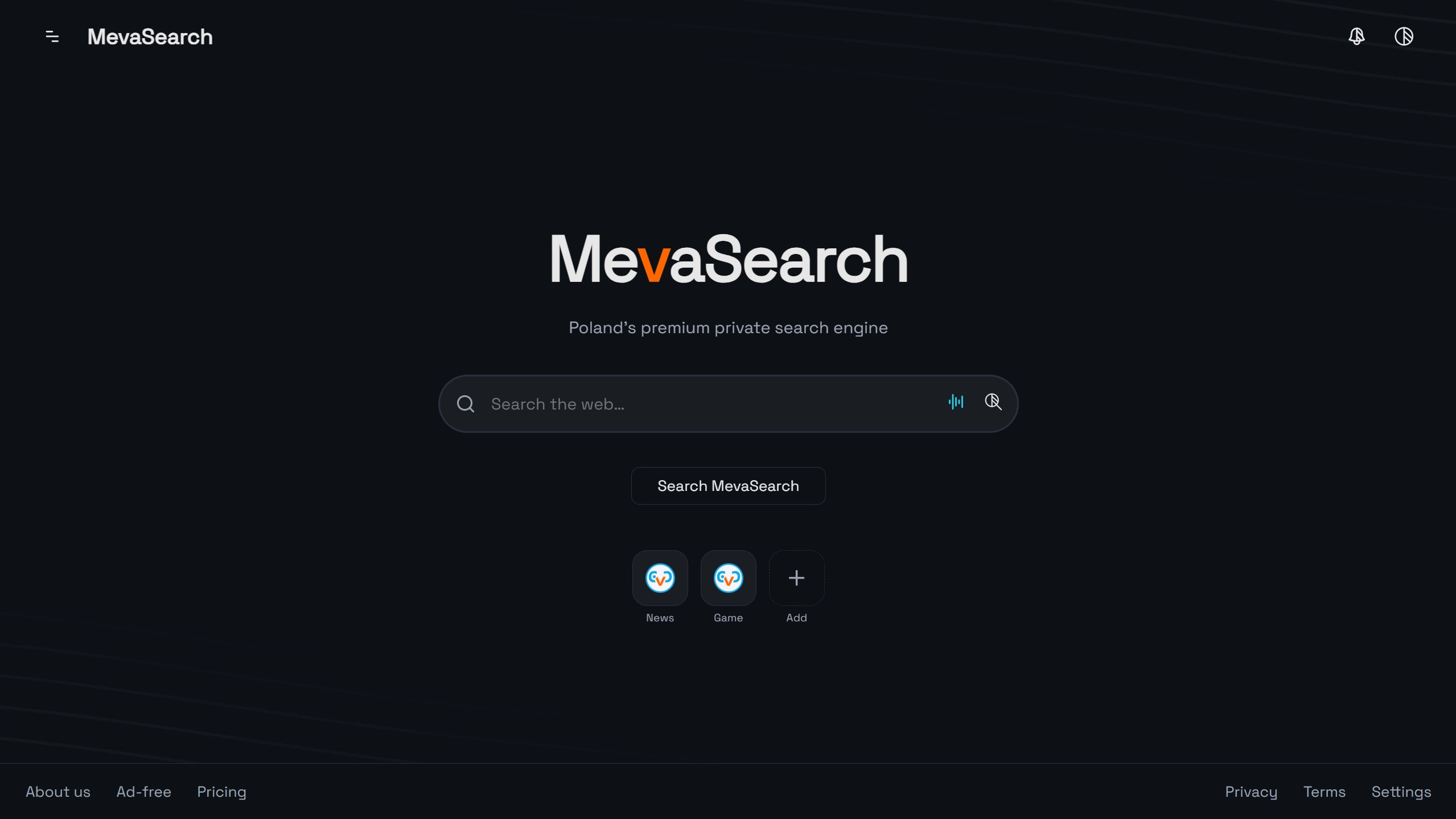
MevaSearch – New player from Poland
MevaSearch is the newest and only Polish search engine on this list. It launched on May 18, 2025 as a project by Ixavence. Initially it used the Google Search API and was free of charge. However, already in October 2025 it moved to its own domain mevasearch.com and integrated the msX Guard system — its own anti-phishing mechanism that scans results in real time and warns against dangerous sites.
The turning point came on March 30, 2026: MevaSearch officially joined the WebOrbiton Team and began a process of "full independence from Big Tech." Two weeks later, on April 15, 2026, it abandoned the Google Search API — the main source of results became the Brave Search API supplemented by its own WebAtlas database. This transition also meant abandoning the free model.
MevaSearch stands out from the competition by separating its fees: you pay separately for search (from $4.99/month) and separately for AI-enriched results (an additional $4.99/month). If you don't need AI, you don't pay for AI. The model is 100% subscription-based, with no ads and no search history stored on your account.

Surfshark Search – a search engine bundled with a VPN
Surfshark Search differs from the other search engines on this list in one fundamental way: it cannot be purchased separately. It is part of the Surfshark One package, which includes a VPN, antivirus, and a data breach monitoring tool. This means Surfshark Search is unavailable without purchasing the broader security service.
Technically, the search engine uses the Bing API as its backend, but removes all tracking links from results and does not store search history. A unique feature is the ability to choose a region — the user can see results as if searching from Germany, the US, or Japan, without actually changing their VPN location. The interface is deliberately minimalist: no "People Also Ask" boxes, no video carousels — just clean organic results.
Why should you consider a paid search engine?
All five services share one conviction: the advertising model structurally conflicts with the user's interest. A search engine funded by advertising is motivated to get users to click on ads and spend more time on the search engine — not to help them find the answer as quickly as possible. A paid search engine has the opposite motivation: the better the results, the higher the subscriber retention.
This is not a theoretical argument. Over the past several years, Google has consistently increased the number of ads above the first organic result, expanded "AI Overviews" at the expense of click-through rates to sources, and prioritized SEO-driven content over genuinely valuable content. All of these decisions were rational from an advertising revenue standpoint.
If you are willing to pay a few dollars a month for a tool you use dozens of times a day — a paid search engine may be one of the best investments in the quality of your digital life.
This article was written objectively; the author has no affiliation with MevaSearch or WebOrbiton.